
How much is South Carolina’s homestead exemption in 2026, and who qualifies?
South Carolina’s homestead exemption for homeowners age 65 and older, or those who are totally and permanently disabled or legally blind, increased from $50,000 to $75,000 of a primary residence’s fair market value as part of the state’s FY2026–2027 budget, signed into law over the summer of 2026. The exemption is applied for through your county auditor’s office — Charleston, Berkeley, and Dorchester counties each run their own intake — and most current recipients don’t need to reapply to get the higher amount. If you or someone in your household is turning 65, becoming permanently disabled, or buying a primary residence in the Charleston area, this is the year to check your eligibility.
By 32 South Properties | October 14, 2026
For nearly 50 years, South Carolina’s homestead exemption knocked $50,000 off the taxable fair market value of a primary residence for qualifying homeowners. That number just changed for the first time in half a century — and a lot of Charleston-area homeowners haven’t caught up with it yet.
If you’re 65 or older, permanently disabled, or legally blind, and you own the home you live in, you’re now eligible to have $75,000 of your home’s fair market value exempted from property taxes before your county even calculates your assessed value. If you’re weighing a move to or within Mount Pleasant, Daniel Island, or Charleston in the next year or two, this is exactly the kind of detail that belongs in your planning — it’s a real number, even if it’s not the biggest line in your budget.
What Changed, and When
The path here wasn’t short. A bill known as S.768 passed the South Carolina Senate unanimously in February 2026, proposing to raise the exemption well beyond $75,000. It then sat in the House Ways and Means Committee for months — the kind of legislative limbo that makes it easy to assume nothing happened.
Something did happen, just through a different door. Rather than passing S.768 as a standalone bill, the General Assembly folded a smaller version of the increase into the state’s FY2026–2027 budget. The final number landed at $75,000 — short of the Senate’s original ask, but a real, funded increase covering roughly $80 million in reimbursements to counties for the lost tax revenue.
Governor Henry McMaster signed the budget and, in his official announcement of line-item vetoes that August, specifically confirmed the exemption increase was funded and untouched — he called it out by name as a budget priority his office chose to protect. You can read the Governor’s own summary of the change, and the South Carolina Daily Gazette’s coverage of the final budget deal walks through how the number came down from the Senate’s larger proposal. Senate Finance Chairman Harvey Peeler has already said he’ll push for a bigger exemption again next session, so this likely isn’t the last change — but for now, $75,000 is the current law.
Who Qualifies, and How Charleston-Area Homeowners Apply
The eligibility rules themselves didn’t change — only the dollar amount did. According to the South Carolina Department of Revenue’s official homestead exemption guidance, you qualify if you meet all three of these:
- You hold title to the home as your primary, legal residence in South Carolina.
- You’ve been a permanent South Carolina resident for a full calendar year.
- You’re at least 65 years old, totally and permanently disabled, or legally blind.
A few practical notes worth knowing before you assume this is automatic:
- You apply through your county auditor, not the state. Charleston, Berkeley, and Dorchester counties each process their own homestead exemption applications. Charleston County’s auditor’s office rolled out an online application several years ago specifically to make the process faster for residents who’d otherwise have to visit or mail in a paper form.
- If you already have the exemption, you likely don’t need to reapply. Existing recipients generally keep their exemption without refiling unless they move to a new home or the qualifying owner passes away, in which case surviving-spouse rules come into play.
- If you’re turning 65, becoming newly disabled, or just bought a home, you do need to apply. The exemption isn’t automatic — it only applies once your county auditor has your application on file.
- Bring proof of age (driver’s license or birth certificate), disability certification if applicable, or documentation of legal blindness when you apply.
What the Increase Is Actually Worth
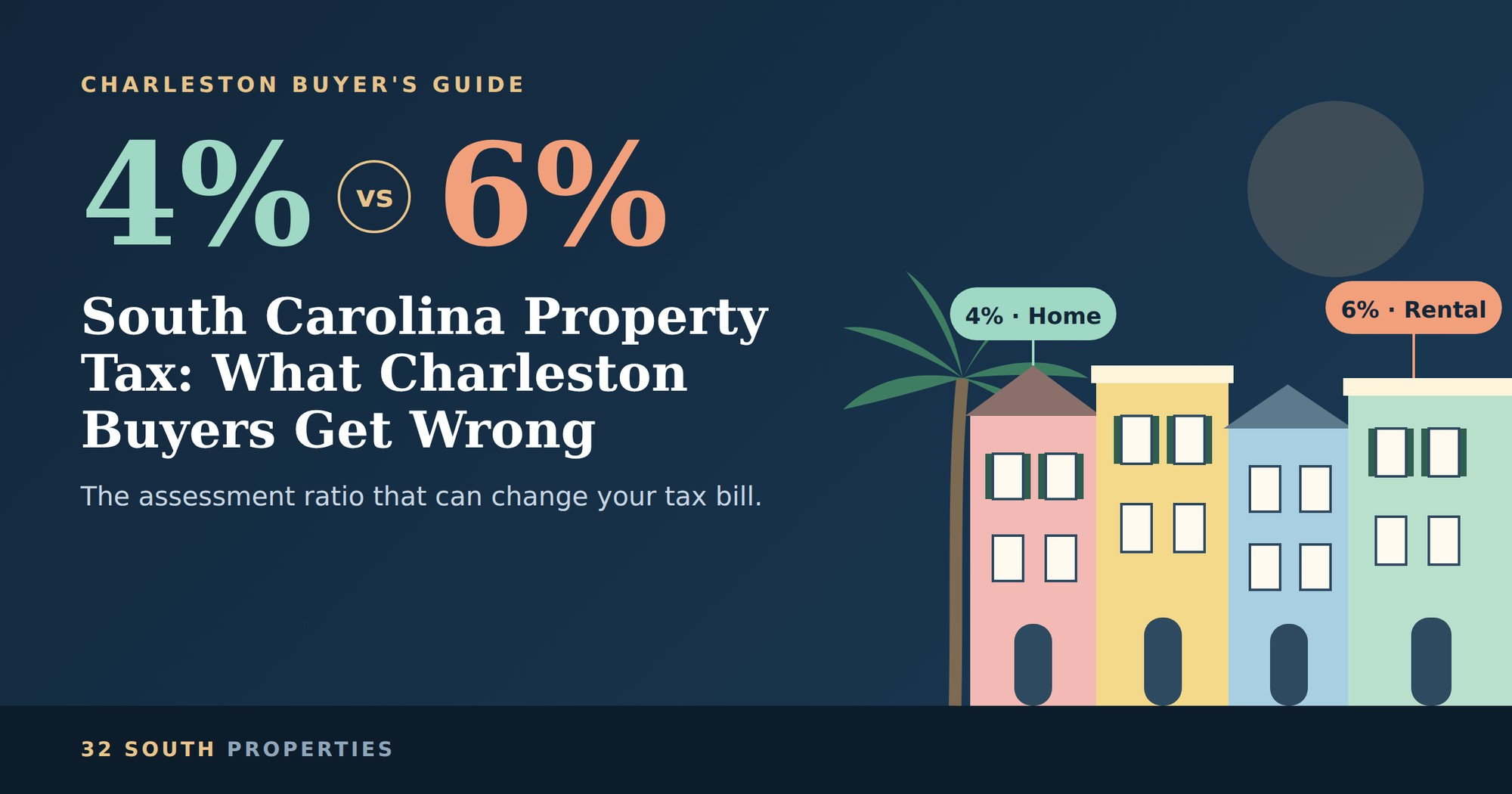
Because the exemption comes off your home’s fair market value before your county applies South Carolina’s 4% owner-occupied assessment ratio, the real dollar impact is smaller than the headline number — but it’s still worth doing the math rather than guessing.
Here’s the mechanism: a $75,000 exemption, run through the 4% assessment ratio, works out to $3,000 less in assessed value than you’d otherwise be taxed on. Multiply that by your specific county, city, and school district millage rate, and you get your actual annual savings. Charleston County has previously estimated that its roughly 25,000 existing homestead exemption recipients were saving an average of about $225 a year under the old $50,000 exemption — since the new exemption is one and a half times larger, most current recipients should see a proportional increase, though your exact number depends on your property’s assessed value and your specific millage rate.
That’s not a number that changes whether you can afford a home in Mount Pleasant or on Daniel Island. But paired with everything else that goes into a moving decision — your home’s current equity, where you’d want to land next, and how the timing lines up with retirement — it’s one more piece of a bigger picture worth working through with someone who can run your actual numbers.
What This Means If You’re Weighing a Move Right Now
This is a modest number in the scale of a $500,000 to $2,000,000+ Lowcountry home purchase — but it’s not nothing, and it’s the kind of detail that changes the math on a decision you might already be sitting on.
If you’re a longtime Charleston-area homeowner thinking about downsizing now that you’re retired, the increased exemption is one more reason the timing might work in your favor — a smaller, easier-to-manage home paired with a bigger property tax break on top of it. We’ve written before about why moving can be the right next step as retirement approaches, and this change adds a concrete number to that conversation.
If you’re on the other side of that decision — buying a primary residence in Charleston, Mount Pleasant, or Daniel Island as you head toward or past 65 — factor the exemption into your ongoing ownership cost estimate, not just your purchase price. It won’t show up on the listing, but it affects what you’ll actually pay every year once you close. It’s also worth remembering that Charleston’s flood zones vary block by block across the peninsula, Mount Pleasant, and Daniel Island, and a property’s flood zone designation affects your insurance costs far more than the homestead exemption affects your tax bill — so it’s worth confirming early in your search, not after you’re under contract.
And if you’re a current homeowner deciding whether to sell as-is or invest in updates before listing, that’s a separate question worth its own conversation — we’ve broken down how to think through selling as-is versus making updates first for Charleston-area sellers weighing exactly that trade-off.
None of this replaces a conversation about your specific numbers. Every homeowner’s assessed value, county, and timeline are different, and the only way to know what the exemption actually saves you — and how it fits into a bigger move or sale — is to run it with someone who knows the local market and the process.
If you’re not sure where you’d even want to land next, we’ve also put together some thoughts on where longtime Charleston-area homeowners consider moving when they sell, which is worth a read if you’re still in the “what if” stage rather than the “when” stage.
Frequently Asked Questions
Do I need to reapply for the homestead exemption now that it increased to $75,000?
No. If you’re already approved for South Carolina’s homestead exemption, the increase applies automatically without a new application. You only need to file again if you move to a different home or if the qualifying owner is deceased, in which case your county auditor can walk you through the surviving-spouse process.
How is the homestead exemption different from South Carolina’s 4% and 6% property tax assessment ratios?
They’re two separate parts of your tax bill, applied in sequence. The homestead exemption first removes $75,000 from your home’s fair market value if you qualify. Then South Carolina’s assessment ratio — 4% for an owner-occupied primary residence, 6% for most other property — is applied to whatever value remains to determine your taxable assessed value.
Where do I apply for the homestead exemption in the Charleston area?
You apply through your county auditor’s office, not the state. Charleston, Berkeley, and Dorchester counties each handle their own applications — Charleston County residents can apply online through the county auditor’s office, while Berkeley and Dorchester County homeowners can find their forms through their respective county government websites.
Does the homestead exemption transfer if I sell my Charleston home and buy another one?
No. The exemption is tied to your specific primary residence, so if you sell and buy a new home, you’ll need to file a new application for the new address once you close, even if your eligibility (age, disability, or blindness status) hasn’t changed.
Is the $75,000 exemption retroactive to earlier tax years?
No — the increase applies going forward from its enactment in the FY2026–2027 state budget. If you believe you were eligible in prior years and never filed, talk to your county auditor’s office about your options, but the increase itself isn’t retroactive on its own.
South Carolina’s homestead exemption increase is a small but real shift for homeowners 65 and older, disabled, or legally blind across Charleston, Mount Pleasant, and Daniel Island — and it’s easy to miss if you’re not the one who tracks state budget news. Whether you’re thinking about downsizing now that the timing feels right, buying your next home in the Lowcountry, or simply making sure your current exemption is on file correctly, it’s worth a real conversation about how it fits your situation. Whether you’re buying or selling in Charleston, Mount Pleasant, or Daniel Island, we’d love to offer a private, no-pressure consultation to talk through your options. Reach out anytime.
About 32 South Properties
32 South Properties is a real estate firm serving buyers and sellers throughout Charleston and the surrounding Lowcountry. Backed by more than 20 years of real estate experience, the team provides personalized guidance, local market expertise, and dedicated support from the first conversation through closing. Connect with 32 South Properties at 32south.com.